
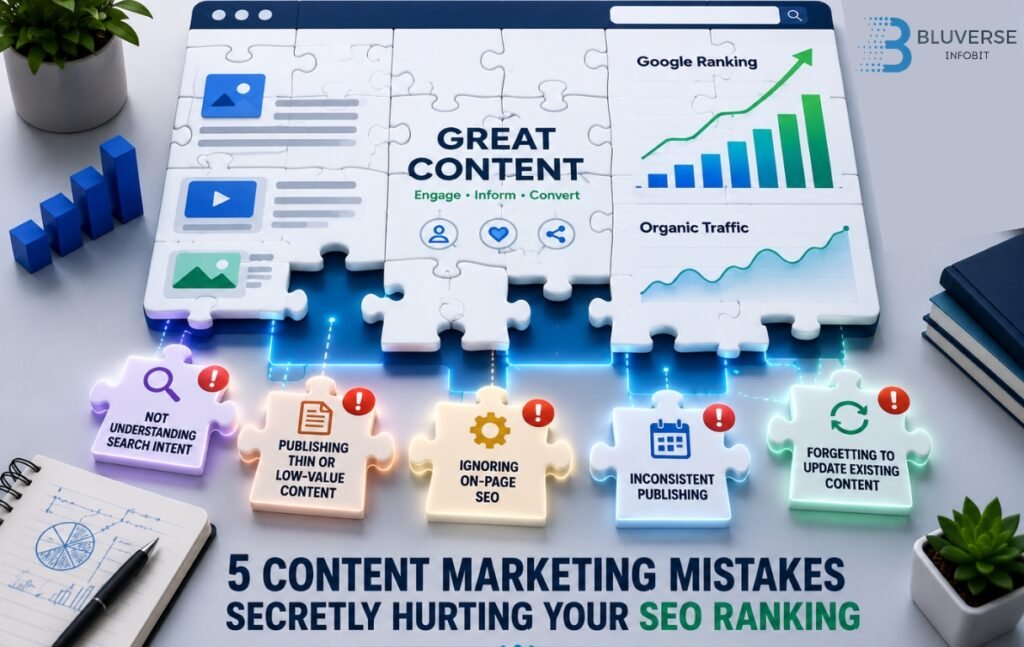
5 Content Marketing Mistakes Secretly Hurting Your SEO Ranking
Introduction Content marketing, when done right, can drive powerful SEO results. But many businesses publish blogs, landing pages, and social content without realizing that a few hidden mistakes are quietly hurting their rankings. You can write content regularly and still not be seen on Google. This normally happens when the content does not match the search intent, is shallow, ignores on-page SEO, or just gets old with time. The good news is that you can fix these issues. In this guide, you’ll learn 5 content marketing mistakes that secretly hurt your SEO rankings and how to fix them so that your website can attract more organic traffic and stronger search visibility. Why Content Marketing and SEO Work Together Content marketing and SEO work best when they work together. Content marketing is about giving your audience useful information to keep them engaged while SEO helps search engines understand and rank your content. Combining the two strategies gives you content that not only performs well but converts better. With good content marketing you can: So, if you want better SEO results you need content that is good for search engines and for real people. Mistake 1: Writing Content Without Understanding Search Intent One of the biggest content marketing mistakes is publishing content without knowing what the searcher actually wants. A lot of businesses pick a keyword and then write down whatever thoughts they have. However, Google prefers content that matches the intent of the search. People search for ‘best CRM software’ because they want comparisons, reviews and recommendations. They do not want a generic overview of the company. To get your content aligned with search intent, you should: Matching search intent to your content makes it more useful, more relevant, and more likely to rank. Mistake 2: Publishing Thin or Low-Value Content Another stealthy SEO rankings killer is publishing thin content. Short articles that offer little insight tend not to do well because they fail to fully answer the reader’s question. Search engines love content that is rich, clear and valuable. Don’t just post a lot of weak posts. Focus on putting out something that actually solves a problem and gives your readers something useful. High-value content should: This, in turn, means visitors stay longer on your page, engage with your content and send stronger quality signals to search engines. Mistake 3: Not paying attention to on-page SEO Great content doesn’t mean anything if you are ignoring on page SEO. Search engines need clear cues as to what your page is about. Your content will never reach its full ranking potential without optimization. To optimize on-page SEO, make sure each article has: Also, use your target keyword naturally in the content. Do not include it in every paragraph. Write instead for clarity and relevance. When you optimize your on-page elements properly, you are making your content easy to understand for the users and the search engines. Mistake 4: Inconsistency With Publishing Most businesses do not understand the importance of consistency. Some brands post a number of articles in a month and then disappear for weeks. Some people post randomly, with no schedule. This inconsistency makes it harder to build momentum, authority and trust. Websites that regularly produce helpful content are loved by search engines. A consistent schedule will allow them to crawl your site more often, seeing your website as an active source of information. To be consistent, create a realistic publishing plan like: The more you publish on a regular basis, the more topical authority you gain, and the better chance you have of ranking for the long haul. Mistake 5: Forgetting to Update Existing Content Many businesses focus on creating content but they forget about the content they already have. Over time old articles can lose rankings. This happens when the information gets old competitors publish content or what people search for changes. If you ignore these pages you miss a chance to get more traffic back. Updating content can boost SEO faster than creating something new. You can update content by: When you update old content you tell search engines that your page is still important. This means you can get your rankings back and keep getting traffic. Additional Content Marketing Tips for Better SEO After avoiding all those common mistakes, there is still more that you can do for an improved content marketing strategy. Write for People First Always write content that adds value for your audience. If your content solves their problems, search engines will pick up on it. Use Internal Linking Link together articles so readers can discover more about your website. At the same time, you make it easier for search engines to understand the website structure. Optimize Images Compress images and add descriptions so you can optimize images for accessibility and SEO purposes. Improve Readability Break up long paragraphs, use bullet points, and add headings so readers can scan your content easily. Include Strong Calls-to-Action Make sure your calls-to-action encourage visitors to contact your team, visit an article or request a particular service. How Better Content Improves SEO By improving your content marketing strategy, you will generally see an improvement in your SEO performance. Better content can help you: In addition to all these benefits, good content will create trust and establish authority. Common SEO Myths About Content Marketing Businesses have various misconceptions that can put them on the wrong path. Here are some common myths that you should avoid. More Content Always Means Better Rankings Quantity doesn’t necessarily win over quality. Usually, some high-quality articles perform better than many low-quality ones. Keywords Alone Guarantee Rankings While key words play an important role in SEO, Google takes into account their relevance and usability. SEO Ends After Publishing SEO is a continuous process where you need to update and improve your content. Every Blog Must Target a Completely Different Keyword Related keywords will be useful if you use them strategically and plan everything ahead. Hence, SEO success requires good content strategy. Measuring Content Marketing